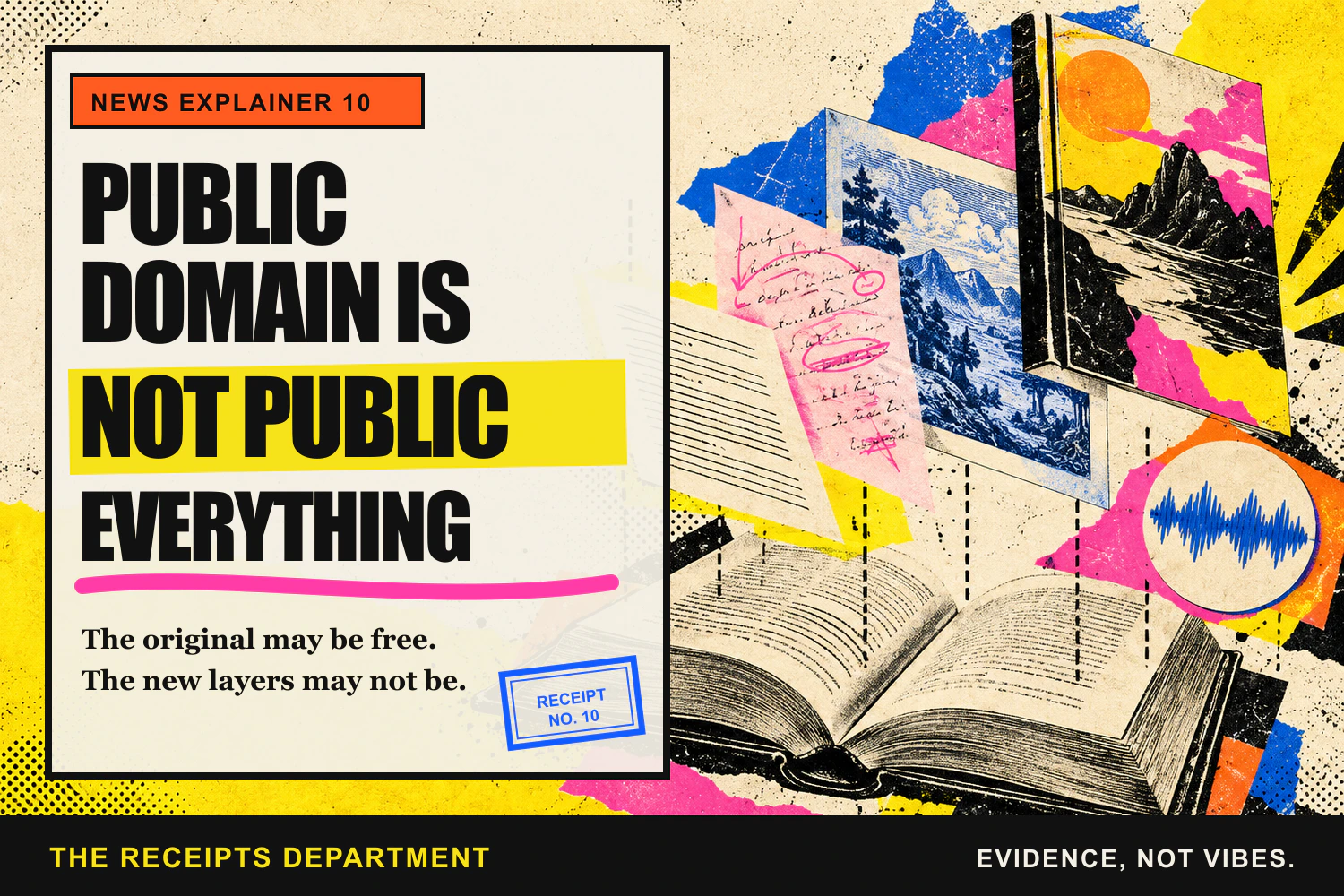
At a glance
- The claim: if the original book is public domain, every modern edition and every element attached to it is free to copy.
- The fact: copyright in a derivative work covers only the new original material contributed by that author.
- The other fact: the new copyright does not create exclusive rights in the underlying public-domain text.
- The missing analysis: which exact element is being copied—the old work, or somebody else’s newer translation, notes, illustrations, recording, or design.
The claim: old book, no rights, take whatever you like
A novel enters the public domain. Someone finds a recent edition, copies the text, the new translation, the introduction, the custom illustrations, and perhaps the cover for efficiency, then announces that public domain means public domain. Are we serious? The legal status of the original work does not answer the status of every later contribution stacked on top of it.
Reality check: the layers can have different rights
The U.S. Copyright Office explains that a public-domain work may be used as the foundation for a derivative work. Copyright in that derivative work covers only the additions, changes, or other new original material. It does not extend to the public-domain material underneath.
That creates a two-way boundary. A publisher cannot claim exclusive ownership of the old novel merely by adding an introduction. Everyone else remains free to use the same public-domain novel. But everyone else is not automatically free to copy that publisher’s original introduction, fresh translation, annotations, illustrations, or other sufficiently creative additions.
Ask what was actually copied
“It is public domain” is incomplete until the sentence identifies what is public domain. The original-language text may be free while a modern translation is protected. The story may be free while newly commissioned cover art is protected. The words may be free while a particular human narration and sound recording carries its own rights.
Not every change earns a new copyright. Routine formatting, mechanical cleanup, and other changes without enough original authorship may not qualify. The point is not that every edition receives a legal force field. The point is that rights attach to specific expression, not to the general vibe of “an old book.”
Platform policy adds another rulebook
Amazon KDP allows public-domain books, but its current policy may require a differentiated edition when a free version is already available. KDP lists original translations, substantial original annotations, and at least ten relevant original illustrations as qualifying forms of differentiation. It also says a linked table of contents or formatting improvements do not count.
That is a retail participation rule, not a declaration that Amazon created new copyright law. A publisher can have the legal right to reproduce a public-domain text and still fail a store’s product or differentiation policy. Conversely, satisfying a platform rule does not grant ownership of the underlying work. Two rulebooks can exist at once. Yes, apparently we do have to read both.
What publishers are actually accountable for
A publisher is responsible for confirming that the underlying work is public domain where it plans to distribute it, obtaining rights to any newer material it uses, describing the edition honestly, crediting contributors, and following the platform’s public-domain rules. The creator of a modern translation, annotation set, illustration, or recording is responsible for the originality and rights in that contribution.
And anyone making a copying claim should identify the layer at issue. Reusing the public-domain text may be lawful. Copying the new additions may not be. A 1905 novel does not become private again because someone designed a handsome edition in 2026—and the handsome edition does not become a free clip-art bin because the novel is old.
This explainer provides general information, not legal advice about the status of any particular work or edition. Copyright terms and public-domain status can vary by country.
Sources and documents
These links support the factual claims in this explainer. Interpretive conclusions are identified in the article and should be read with the underlying record.